AI Memory vs. Context Window: Why the Difference Actually Matters
Honestly, for a while I figured AI memory and context window were just two ways of saying the same thing. Turns out I was wrong, and it took a few frustrating hours to actually understand what was going on.
It started during a long project with an AI assistant — research notes, back-and-forth drafts, decisions made earlier in the conversation that were supposed to carry forward. At first it felt like magic. The model seemed to "get" the project. Then, a few days into the same thread, things started slipping. Details mentioned an hour earlier got dropped. A decision from the day before got contradicted outright. Hadn't that already been settled? Why did it suddenly feel like talking to someone with amnesia?
That question led down a rabbit hole, and the answer turned out to be almost embarrassingly simple: the AI wasn't "forgetting" the way a person forgets. It was running out of room. That room has a name — the context window — and it's a genuinely different thing from memory, even though the two terms get thrown around interchangeably almost everywhere, this article included until the distinction actually clicked.
Key takeaways
- A context window is temporary — the amount of text a model can actively process in one go, measured in tokens, not words.
- Memory is different — information deliberately stored outside the conversation and reinserted later, so it survives past a single session.
- A bigger context window isn't automatically better: it costs more to process, slows responses, and models often pay less attention to details buried in the middle of a long input.
- When an AI seems to "forget," it's usually not being careless — the conversation simply outgrew its window and the earliest parts got dropped to make room.
- A tool can have a huge context window and no real memory, or a modest window and still feel like it "remembers" — the two features are independent of each other.
What was actually happening
The assumption going in was that the AI took notes like a person would — everything jotted down somewhere permanent, ready to be flipped back to whenever needed. That's not remotely how it works, and once the real mechanism became clear, a lot of the odd behavior suddenly made sense. Every time a message goes out, the model isn't recalling the past conversation the way a person recalls last week. Instead, the entire conversation, every message sent and every reply given, gets fed back into the model fresh, as one big block of text with a hard size limit. That limit is the context window. Once a conversation grows past it, the oldest parts get pushed out to make room — not because the model chose to forget them, but because there's no physical room left.
Picture a whiteboard with a fixed size: write as much as needed, but once space runs out, the earliest lines get erased to make room for new ones. The AI isn't being forgetful on purpose — it's working within the size of its whiteboard, and that whiteboard is smaller than it seemed at first.
Tokens, not words
One early trip-up was assuming context windows were measured in words, like a word count on a document. They're actually measured in tokens, and a token isn't quite a word — sometimes a whole word, sometimes a fragment, sometimes just a punctuation mark. A rough rule of thumb: about one and a half tokens per word, give or take.
Once that clicked, the numbers thrown around for different models finally made sense. A "200,000 token" window versus a "1 million token" window used to sound like marketing noise. Doing the math changes that: a million tokens works out to roughly 750,000 words, close to ten or fifteen full novels, all visible to the model at once. Model sizes vary a lot in practice — some sit around 128,000 to 200,000 tokens, others push well past a million, with a handful reaching into the several-million range.
A concrete example makes the scale easier to picture. A 300-page report, a dense technical manual or a full annual filing, usually works out to somewhere around 150,000 to 200,000 tokens. Dropped into a 200,000-token window, that single document already eats up most of the available space, leaving little room for follow-up questions. Drop the same document into a 1-million-token window instead, and it barely makes a dent — there's still room for several more reports like it, plus a long conversation about all of them.
Why bigger isn't automatically better
The obvious next thought: just use the model with the biggest window and the whole problem disappears. That turned out to be wrong in a few ways that changed how these tools get used day to day.
First, a bigger window costs more to run, and not in a small, linear way. Doubling the input text roughly quadruples the computational effort behind the scenes. A giant context window isn't free — it shows up as slower responses, higher cost, or both. Long, messy conversations noticeably drag compared to short, focused ones.
Second, and this one was genuinely surprising, a bigger window doesn't guarantee the model uses everything inside it well. Models tend to pay closer attention to information at the very beginning or end of a long context and gloss over the middle. Paste a 25-page contract into a chat and ask two questions: one about a clause on page one, another about a clause buried on page 14. The first answer usually comes back sharp and confident. The second is far more likely to be vague or missed entirely, even though both clauses were technically well within the limit the whole time.
Third, there's a security angle worth knowing. The longer and more complex the context, the more room there is for manipulative instructions to be hidden inside a document or webpage the model is reading, and followed without anyone noticing. Not something a search engine ever had to worry about, but a real consideration with a system that treats everything in its window as material to potentially act on.
Where actual memory comes in
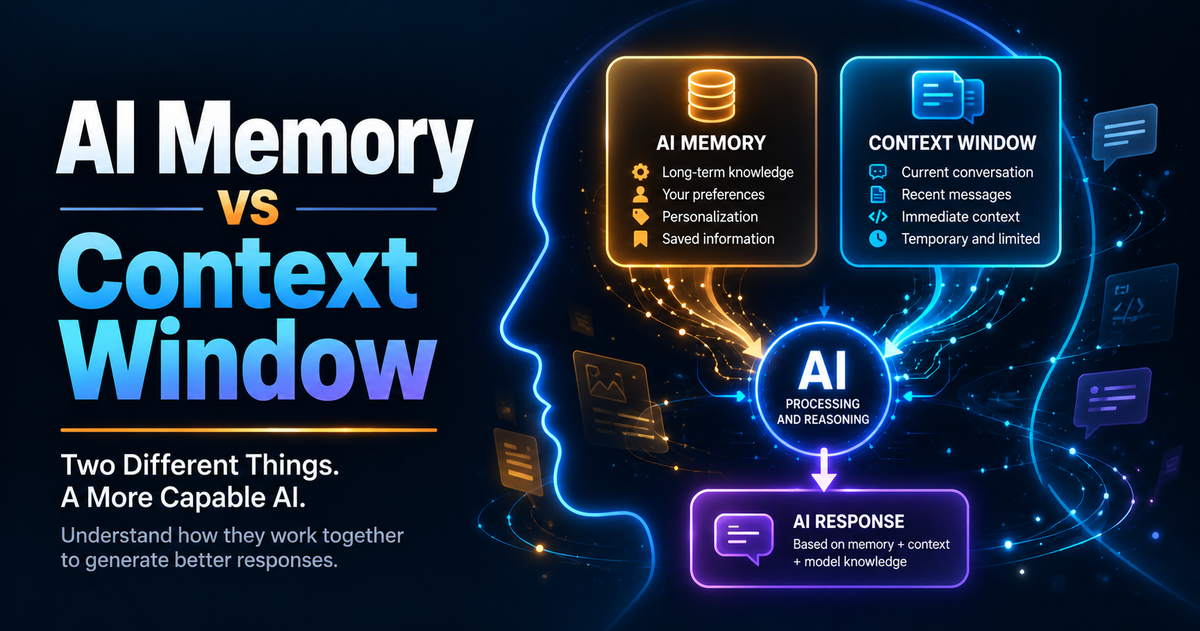
A context window is temporary — it exists for one session, and once that session ends, the information is gone unless something else saved it. Real memory, the kind that persists across separate conversations, works differently: it's information deliberately stored outside the conversation, in a database or external store, then pulled back in whenever it's relevant again.
Simplest way to hold the distinction: the context window is what's actively in mind mid-conversation. Memory is the notebook written down and reread later. A system can have a huge window and zero memory if nothing ever gets written to that notebook — or a modest window and still feel like it "remembers," if it's quietly pulling saved preferences back in each time.
An everyday example makes the split obvious. A support chatbot that opens a new chat with "looks like your subscription renews next month, still want the same plan?" isn't scrolling back through months of old transcripts to find that — it's pulling one saved fact from a database and slotting it into a brand-new, otherwise empty context window. Compare that to a coding assistant deep into a single marathon session, still technically "remembering" everything said an hour ago only because that entire hour is still sitting inside its current window. The moment that session ends, unless something explicitly saved it, all of it is gone. Same appearance of "remembering," two completely different mechanisms underneath.
Some newer systems even decide what's worth saving into that notebook using a kind of "surprise" measure, prioritizing unexpected moments over routine, predictable ones. That tracks with how human memory tends to work too: the ordinary parts of a week blur together, but the one unexpected moment stands out.
Conclusion
The confusion at the start wasn't really about the technology being too complicated — it was that nobody had laid out the distinction in plain terms. The context window is the amount of text a model can actively look at right now. Memory is whether anything from that gets deliberately saved for later. Once that separation is clear, a lot of behavior that looks like the AI being "unreliable" turns out to be a simple boundary issue: either the conversation outgrew its window, or nothing was ever set up to persist past the session. Knowing which one is happening turns a frustrating dead end into a two-minute fix — trim the conversation, restart it, or look for a tool that actually offers persistent memory instead of a bigger window.
FAQs
Is a context window the same as an AI's memory?
No. A context window is the amount of text a model can actively process in one go, measured in tokens. It resets with a new session. Memory is information deliberately stored outside that window — in a database or similar system — and reinserted later, so it can persist across separate conversations.
What exactly is a token?
A token is the basic unit a model processes — sometimes a whole word, sometimes a fragment, sometimes a punctuation mark. As a rough estimate, one word works out to about 1.5 tokens.
Roughly how much text fits in a large context window?
A window of around 1 million tokens holds somewhere near 750,000 words — comparable to ten to fifteen novels. Actual limits vary widely by model, from around 128,000 tokens on the smaller end to well over a million on the larger end.
Does a bigger context window always mean better answers?
Not necessarily. Larger windows cost more to process, tend to slow response times, and don't guarantee the model uses everything evenly — information buried in the middle of a long input is often paid less attention than content at the start or end.
Why does an AI seem to "forget" things mid-conversation?
Usually because the conversation has grown past the model's context window, so the earliest parts get dropped to make room for new input. It isn't a deliberate choice — it's a hard size limit. Starting a fresh, more focused conversation is often the quickest fix.
Can an AI tool have a small context window but still "remember" me across sessions?
Yes, if it has a separate memory system that stores preferences or past details outside the conversation and reloads them each time. That's a distinct feature from context window size, and worth checking for separately.